
A medical appointment can turn into a treatment plan. A parent can suddenly need help at home. A new child can arrive while a team is already stretched thin. In those moments, an employee may be trying to answer two urgent questions: Can I step away from work, and what will happen while I am gone?
For employers, there are questions too. Who will cover the work? Which forms are needed? What can a manager reasonably ask? Understanding the Family and Medical Leave Act, or FMLA, gives both sides a place to begin. In Massachusetts, Rhode Island and Connecticut, that conversation also needs to include state leave programs.

What federal FMLA makes possible
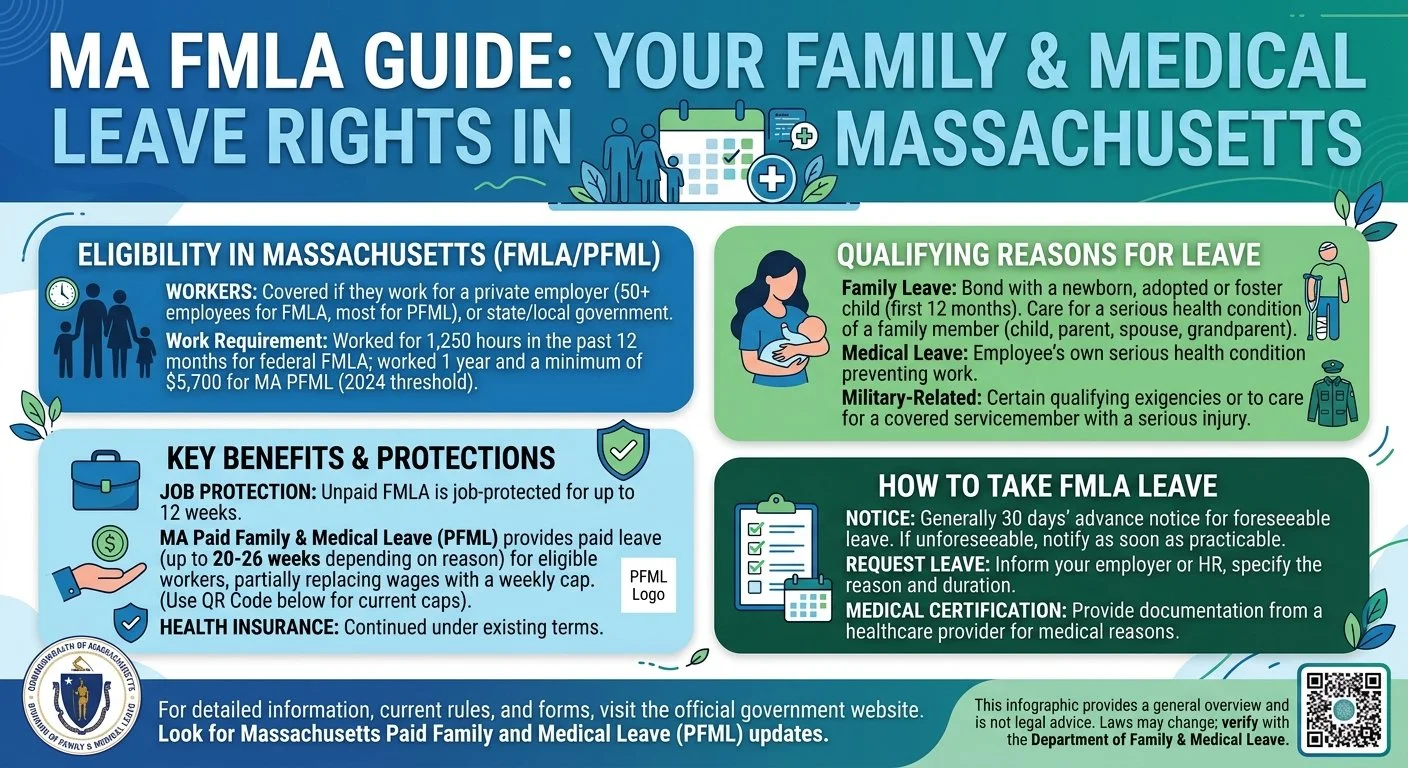
Federal FMLA generally provides eligible employees with up to 12 workweeks of job-protected leave in a 12-month period for qualifying family and medical reasons. Group health coverage continues on the same terms, and employees generally return to the same or an equivalent job. The federal law itself does not require paid leave. A separate military-caregiver provision can allow up to 26 workweeks in a single 12-month period. U.S. Department of Labor overview
Qualifying reasons include a worker's serious health condition, care for a spouse, child or parent with a serious health condition, and birth, adoption or foster placement. Some military-family needs also qualify. Leave can sometimes be taken in smaller blocks or through a reduced schedule, rather than one uninterrupted absence. Federal FMLA guidance
Mental health deserves the same thoughtful attention. A condition involving inpatient care or qualifying continuing treatment may support FMLA leave. Eligibility depends on the circumstances; a diagnosis alone does not automatically establish entitlement. DOL mental health guidance
Coverage needs an individual check
For most employees, federal eligibility requires at least 12 months with the employer, 1,250 hours worked during the preceding 12 months, and a worksite with at least 50 employees within 75 miles. Private employers generally become covered at 50 employees for 20 workweeks in the current or previous calendar year. Public agencies and elementary and secondary schools have different employer-coverage rules. FMLA eligibility and coverage
A smaller employer or a recently hired employee should still check state protections. A federal eligibility answer does not resolve every leave question. Remote work also deserves care: for federal FMLA, the relevant worksite is generally the office to which the employee reports or from which assignments are made, rather than the employee's home. DOL telework guidance
What changes across Massachusetts Rhode Island and Connecticut
Massachusetts PFML can provide eligible workers with partial wage replacement and job protection: up to 20 weeks for their own serious health condition, 12 weeks for family leave, and a combined maximum of 26 weeks in a benefit year. Military-caregiver leave has its own 26-week allowance within that overall limit. The qualifying reason and available balance determine the actual entitlement. Massachusetts PFML overview
Rhode Island separates Temporary Disability Insurance, or TDI, for a worker's own qualifying condition from Temporary Caregiver Insurance, or TCI, for caregiving and bonding. TCI provides up to eight weeks in 2026. Importantly, TCI includes employment protections, while TDI alone generally does not require an employer to preserve the job. Other leave laws may supply that protection. RI benefits overview and employer guidance
Connecticut also separates the questions. CT FMLA generally provides qualifying employees of covered employers with job-protected leave after three consecutive months of employment. CT Paid Leave provides income replacement under its own eligibility rules. Applying for payment does not, by itself, establish job protection. CT FMLA guidance and CT Paid Leave explanation

A clear process can make a hard moment easier
An employee should be able to describe a need for time away without first becoming a leave-law expert. Managers can listen, explain who handles leave requests, and connect the employee with that person promptly. Medical paperwork should go through the appropriate confidential process, rather than become a topic for the team.
At the same time, employers can make practical coverage plans. Identify essential responsibilities, name a temporary contact, and decide how work will be reassigned. Give coworkers the information needed to do their jobs without sharing private health details. These are sensible management steps, not a substitute for the required notices and protections.
Avoid assuming that every available program adds another block of time. When an absence qualifies under federal FMLA and a state paid-leave program, the protections can run together. Pay coordination and the use of accrued time require a separate review. DOL guidance on overlapping paid leave
A useful first conversation ends with a clear next step: which programs may apply, who handles each application, what documents are due, and when the employee will receive an answer. That clarity leaves everyone better prepared to manage the work while giving the person taking leave room to address the reason they need it.
General information, verified October 13, 2026. Eligibility and obligations depend on the facts and applicable law. This article is not legal advice.